What Exactly Is a Ready Commercial Opportunity?

The Anatomy of a Lead vs. an Opportunity
Decoding the Vocabulary: Lists, Signals, and Demos
The Shift from Cold Data to Buying Intent
Case Study: Turning Signals Into Conversations
Why This Saves Time for Lean Sales Teams
Identifying the "Why Now": A Practical Exercise
A lead is not the same thing as an opportunity. In modern B2B sales, confusing a simple email address with a genuine buying interest is a costly mistake that exhausts sales teams and frustrates buyers. A raw contact is only data resting in a database. It lacks the critical dimensions required to initiate a meaningful business exchange. A ready commercial opportunity, however, is a dynamic entity. It combines the right timing, a precise business context, a strict alignment with the Ideal Customer Profile (ICP), and a compelling reason to start a conversation right now. Understanding this distinction is the foundation of modern revenue generation.
The Key Takeaways
- A B2B lead is a static piece of contact information, whereas a ready commercial opportunity represents a specific moment when a prospect exhibits an active need.
- Moving from leads to opportunities requires adding real-time buying signals and context to standard profile data.
- Using platforms capable of detecting moments of buying intent in real-time, like MeetMagnet, allows teams to shift from blind outreach to highly relevant, timely conversations.
- Prioritizing opportunities over raw leads protects the mental bandwidth of sales teams and ensures a more sustainable, targeted approach to business growth.
The Anatomy of a Lead vs. an Opportunity
A contact profile becomes useful only when you know how to use the information it contains. In traditional sales models, representatives spend hours dialing numbers from a static spreadsheet. This data includes names, job titles, and company sizes. However, standard demographic data does not indicate whether the company actually needs a new solution today.
To turn that static data into a ready opportunity, several elements must align. First, the prospect must fit your Ideal Customer Profile perfectly. Second, there must be a specific context—perhaps the company just raised funds, hired a new executive, or expanded into a new sector.
Finally, there must be precise timing. Timing is the trigger. Without a clear "why now," outreach messages sound generic and are quickly deleted. When you identify the exact moment a prospect is open to change, the conversation naturally shifts from an interruption to a helpful consultation.
À retenir :
A raw lead provides who to contact, but a ready opportunity provides the why and the when. Transitioning from basic data collection to signal detection is what transforms cold calling into smart calling.
Decoding the Vocabulary: Lists, Signals, and Demos
To master the mechanics of ready commercial opportunities, we must clarify the terminology used daily by revenue teams. The journey from a name to a closed deal involves distinct phases.
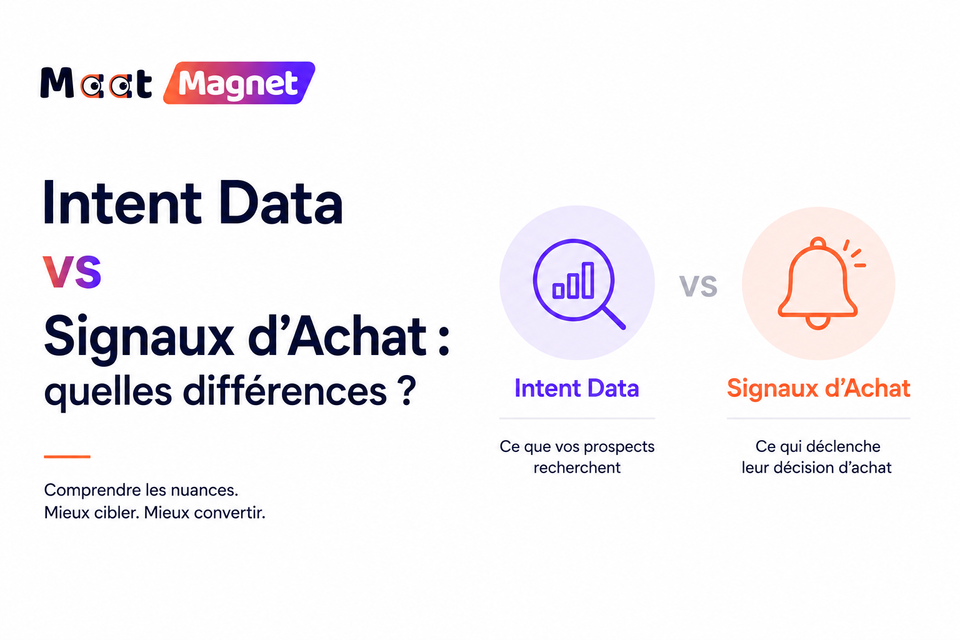
A contact list is simply a directory. It is a compilation of professionals who might vaguely need your services one day.
A signal is an observable action or event indicating a potential shift in priorities. This could be a post on LinkedIn asking for advice, a sudden surge in hiring for a specific department, or a change in leadership.
A qualified opportunity happens when that signal is verified. The prospect has acknowledged the problem, fits your target audience, and has agreed to explore solutions. Finally, a demo is the structured presentation where the solution is mapped directly to the prospect's acknowledged pain points.
Data supports the need to move past simple contact lists. According to Forrester Research, 68% of B2B buyers prefer to research independently and only engage with vendors who provide highly contextual, relevant information tailored to their immediate workflow challenges. Sending generic emails to a list ignores this reality.
À retenir :
Understanding the difference between a static list, a behavioral signal, and a qualified opportunity helps sales teams allocate their time effectively. Engaging only when a clear signal is present drastically improves conversion rates.
The Shift from Cold Data to Buying Intent
Relying solely on volume-based outreach is no longer viable. Buyers are saturated with automated messages. When sales representatives focus purely on lead volume, they suffer from low response rates and workflow fatigue.
This is where the concept of sustainable sales practices comes into play. Constantly chasing cold data leads to rapid burnout among commercial teams. Furthermore, generic outreach lacks inclusivity; it treats all prospects the same, ignoring their unique business contexts and immediate pressures.
By waiting for or actively monitoring buying intent, teams can practice a more respectful, targeted form of business development. They engage only when they can offer genuine value, honoring the prospect's time and their own.
À retenir :
Moving away from mass outreach toward intent-based prospecting creates a healthier work environment for sales teams. It fosters a sustainable business model where quality interactions systematically replace spam.
Case Study: Turning Signals Into Conversations
Let us look at a practical, simple example of how this transition works in the field.
Imagine a prospect posts a question on a professional network about optimizing their internal workflow. This is a fresh signal. A traditional sales representative working from a static list would not see this and might send a generic product pitch three weeks later, which will be ignored.
In contrast, a modern approach utilizes AI to capture this moment. A platform like the French SaaS MeetMagnet identifies this context instantly. It automates the identification and initial contact by cross-referencing the signal with the prospect's profile. Instead of a cold pitch, the sales team receives a specific message angle tailored to the prospect's exact question.
Because MeetMagnet integrates social selling seamlessly, the representative can engage the prospect on the platform where the signal originated. This smart timing drastically increases response rates because the message arrives exactly when the prospect is actively seeking a solution.
Below is a comparison of how different operational models handle the prospecting workflow:
| # | System Approach | Data Type | Timing Strategy | Message Quality |
|---|---|---|---|---|
| 1 | MeetMagnet | Dynamic Intent Signals | Real-time action based on buying signals | AI-generated, highly personalized context |
| 2 | Traditional Database | Static Demographics | Random or cyclical | Generic, template-based |
| 3 | Basic Email Automation | Behavioral (Opens/Clicks) | Sequential delays | Semi-personalized (Name/Company only) |
À retenir :
Capturing a fresh signal and addressing it immediately changes the dynamic of the sale. Tools that reduce manual work for sales teams by generating relevant messages based on immediate context turn cold targets into engaged conversational partners.
Why This Saves Time for Lean Sales Teams
Small and medium-sized enterprises often operate with lean commercial teams. These professionals cannot afford to spend 60% of their day sorting through unqualified data or writing manual emails to people who are not ready to buy.
Gartner reports that B2B sales representatives spend only 21% of their time actually selling, with the rest lost to administrative tasks and research. By adopting an AI-driven intent model, organizations change this ratio.
When a system focuses on real user experience and fast onboarding, representatives spend less time learning software and more time talking to buyers. By maximizing campaign ROI through precise targeting, lean teams can compete with much larger organizations. They let technology find the needle in the haystack, allowing human representatives to focus entirely on building the relationship and closing the deal.
À retenir :
Lean teams achieve scale not by hiring more representatives, but by eliminating wasted effort. Focusing only on ready opportunities ensures that every minute spent selling is directed toward a prospect who actually wants to listen.
Bloc à compléter par les avis et témoignages clients nominatifs
Identifying the "Why Now": A Practical Exercise
The theory of ready opportunities is straightforward, but the transition requires a practical shift in daily habits. Sales professionals must train themselves to look for the trigger before they pick up the phone or write an email.
Review your last 20 leads. Look at the data you have in your CRM right now. Ask yourself which of those 20 contacts had a clear "why now."
Did any of them just receive funding? Did they recently announce a strategic shift? If you cannot find a specific reason why they need to talk to you today, they are merely leads, not opportunities. By identifying the missing context, you can pause your outreach until a valid signal appears, saving your energy for the prospects who are genuinely ready to engage.
À retenir :
Regularly auditing your pipeline to separate raw data from actual buying signals is a necessary discipline. It forces revenue teams to prioritize relevance and timing over simple activity metrics.
Foire aux questions
What exactly is a buying signal in B2B?
How does an opportunity differ from a qualified lead (MQL/SQL)?
Can artificial intelligence really personalize sales outreach?
Why are traditional cold calling response rates declining?
The evolution from chasing static leads to engaging with ready commercial opportunities marks the maturation of the B2B sales profession. It represents a fundamental shift from pushing an agenda to answering a demonstrated need. By understanding the vital differences between a raw contact, a behavioral signal, and a truly qualified conversation, revenue teams can stop wasting resources on deaf ears. Embracing tools and mindsets that prioritize context and timing allows modern professionals to practice a more intelligent, respectful, and ultimately more successful form of commerce. It is no longer about how many people you can reach, but how accurately you can read the signals they are already sending.
絡まりにくさは長時間のイベントや移動で差が出るため、毛質や保管方法も選ぶ基準になります。色味の違いを確認する場面では、着せ恋 コスプレ用ウィッグが撮影時の印象を比べる手がかりになります。キャラクター再現を高めるには、髪色だけでなくシルエットも大切です。