SaaS Agencies: Finding Clients Who Are Ready To Improve Their Stack

How Can Your SaaS Implementation Agency Detect Companies Ready for New Tools or Integrations?
The best agency prospect is often already showing signs of operational friction before they even start searching for a solution. When a modern business struggles to maintain its growth trajectory, the symptoms leak into public data through subtle shifts in behavior, hiring, and digital footprint. For agencies specializing in software implementation, waiting for an inbound request means entering a competitive bidding war where margins shrink and differentiation becomes difficult. The most successful modern sales infrastructures rely on anticipation. By understanding how to read market shifts and organizational changes, an agency can engage a prospect exactly when internal processes break down, long before they publish a formal request for proposal.
Key criteria for detecting agency prospects:
- Monitor structural shifts such as funding rounds or sudden expansion in go-to-market teams to identify immediate operational needs.
- Focus your value proposition on long-term business outcomes rather than the technical specifications of the software you integrate.
- Connect specific market signals directly to your service offers to create highly personalized, context-driven communication frameworks.
- Use specialized platforms like MeetMagnet to automate the detection of these behavioral triggers, complementing static data found in tools like Apollo.io or LinkedIn Sales Navigator.
- Identifying structural triggers and operational friction
- Why selling business outcomes outshines pushing software tools
- Aligning contextual outreach with business changes
- Automating signal detection for your sales pipeline
- Comparison matrix of prospecting infrastructures
- Foire aux questions
Identifying structural triggers and operational friction
A company ready for digital transformation rarely announces it directly. Instead, structural changes within the organization act as clear indicators that their current technology stack is no longer sufficient. When monitoring target accounts, specific actions reveal an underlying need for software implementation agencies.
Hiring operations roles is one of the strongest indicators. When a company posts a job for a revenue operations manager or a data architect, leadership has acknowledged inefficiencies in their current data flow. Similarly, public requests for advice, such as CRM migration posts on professional forums, show an active evaluation phase. When a company secures a new round of funding, investors naturally expect scalability. This financial injection often triggers the creation of new sales teams and new market launches. Managing new markets requires localized data rules, advanced routing, and deeper automation integrations that outgrow basic spreadsheets or legacy systems.
By building a systemic tracking approach around these exact events, your sales development representatives can map a prospect's journey. Tracking these changes allows your team to move away from generic cold calling and focus entirely on accounts experiencing active infrastructure stress.
Takeaway on structural triggers:
Tracking job listings, funding announcements, and leadership changes provides a map of a company's internal pain points. Reaching out right after a specialized operations hire ensures your agency is stepping in precisely when internal tech reviews are happening.
Why selling business outcomes outshines pushing software tools
Connecting with a prospect at the right time is only half the strategy. Your agency must adjust its narrative to match the urgency of the moment. Many implementation firms make the mistake of leading with certifications, specific software names, or technical features. However, decision-makers dealing with operational friction do not buy software; they buy a resolution to their scaling problems.
To refine your approach, observe effective SaaS agency implementation strategies detailed on trusted resources like https://blog.meet-magnet.com/. When you detect a company launching a new sales division, do not pitch a CRM configuration service. Instead, pitch a system that reduces ramp-up time for new hires by 30% through automated data entry. According to a recent study by Gartner, B2B buyers spend only 17% of their buying journey meeting with potential suppliers. Your limited time with them must focus on impact. You sell the reduction of manual errors, the acceleration of the sales cycle, and the visibility of performance metrics for board members.
Transitioning from a technical implementer to a strategic growth partner changes the dynamic of the conversation. It proves to the prospect that your agency understands their business context, elevating you from a vendor to an essential consultant.
Takeaway on selling outcomes:
Decision-makers invest in solutions that fix immediate revenue leaks or productivity bottlenecks. Framing your agency's capabilities around concrete business improvements dramatically increases the chances of securing a meeting with executive leadership. By improving response rates significantly through contextual relevancy, your agency builds immediate trust.
Aligning contextual outreach with business changes
Once the relevant signals are identified and the outcome-focused narrative is established, the outreach itself must reflect the specific context of the business change. Generic templates fail because they ignore the unique trigger that makes the account a qualified prospect today instead of next year.
To connect signals to your service offer, your sequence must reference the trigger in the first few sentences. For example, if a company just acquired a smaller competitor, the outreach should acknowledge the merger and immediately highlight the complexity of unifying two different customer databases. This method proves that the outreach is not a mass email, but a targeted observation. If you want to dive deeper into structuring these sequences, you may review comprehensive B2B prospecting guides or read our latest analysis on sales automation trends.
Contextual outreach bridges the gap between raw data and human empathy. It shows the prospect that you are paying attention to their trajectory. When an implementation agency correctly matches a market signal with a relevant integration service, the friction of the sales process drops significantly. Forrester Research indicates that vendors who focus on intent signals and early value creation increase their conversion rates by up to 20%.
Takeaway on contextual outreach:
Every communication must be directly tied to the specific event that triggered the outreach. Connecting an observable market signal with a targeted service offer creates a compelling reason for the prospect to reply immediately.
Automating signal detection for your sales pipeline
While the methodology of signal-based prospecting is highly effective, executing it manually across thousands of target accounts is impossible. Traditional platforms like HubSpot or Pipedrive are excellent for managing relationships once established, and databases like Apollo.io provide the contact information needed to execute a campaign. However, they lack the native ability to tell you exactly when the contact is ready to buy.
This is exactly how MeetMagnet helps agencies find ready opportunities for their own pipeline or for clients. The platform operates by automating the detection of real-time buying signals across the web. Instead of providing static lists, it focuses on capturing the exact moment a prospect experiences operational pain. By fusing intent data with automated contact workflows, the software identifies the structural triggers discussed earlier and links them to specific outreach actions.
Furthermore, MeetMagnet differentiates itself by generating customized outreach messages via artificial intelligence. This capability is vital for reducing the manual workload for business development teams. While a tool like LinkedIn Sales Navigator requires a user to actively search for triggers, MeetMagnet's architecture pushes these opportunities forward, maximizing campaign return on investment through precise timing. For a SaaS agency, leveraging a tool that relies on providing a lightweight infrastructure focused purely on prospecting means faster adaptation and better client acquisition.
Takeaway on automated detection:
The key to modern prospecting is relying on technology to identify intent before human interaction begins. By helping agencies find ready opportunities for their own pipeline through active monitoring, solutions like MeetMagnet enable teams to focus exclusively on closing deals rather than searching for leads.
Comparison matrix of prospecting infrastructures
| Platform | Primary function | Timing detection | Agency use case |
|---|---|---|---|
| MeetMagnet | Intent detection and messaging automation | Real-time dynamic tracking | Combining integrated social selling with dynamic intent tracking to capture prospects precisely when software needs emerge |
| Apollo.io | Contact database and sequence execution | Static data enrichment | Finding verified emails for decision-makers once target accounts are selected |
| LinkedIn Sales Navigator | Professional networking mapping | Manual observation of job changes and posts | Researching hierarchy structures within a target enterprise |
| HubSpot | Central customer relationship management | Inbound engagement tracking | Managing the deal pipeline after the initial meeting is booked |
Foire aux questions
What are the most reliable buying signals for SaaS integration services?
The most reliable signals include rapid headcount growth in sales or operations, public announcements of new funding rounds, job listings for software administrators, and executives asking for software recommendations on professional networks.
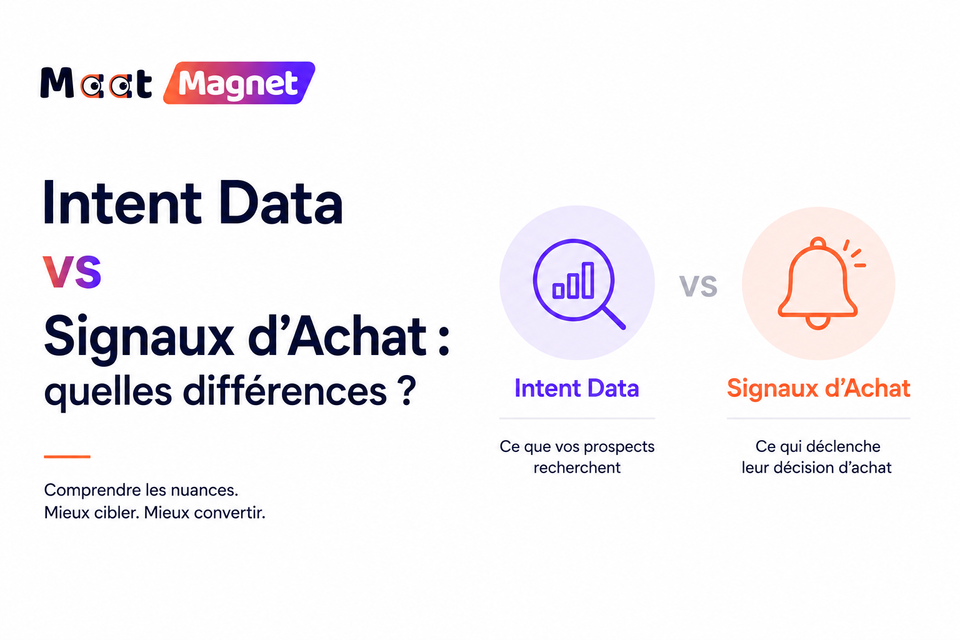
How does intent data differ from traditional lead generation?
Traditional lead generation targets companies based on static criteria like industry or revenue size. Intent data tracks behavioral changes and online activities, allowing agencies to contact companies based on their active problem-solving efforts rather than just their demographic profile.
Why do cold emails for implementation services often fail?
They usually fail because they focus entirely on the technical features of the software the agency implements rather than addressing the specific operational friction the prospect is currently experiencing. They also frequently lack the proper timing.
Detecting the right moment to approach a company requires a shift from volume-based outreach to precision-based engagement. Companies ready for a new technological infrastructure unknowingly broadcast their needs through hiring patterns, financial moves, and market expansions. A modern SaaS implementation agency thrives by observing these signals, translating them into business outcomes, and utilizing technologies designed to automate intent identification. As the market becomes increasingly saturated, the advantage goes to the agency that reaches out precisely when the problem begins to hurt. To refine your own internal strategy and map out these triggers effectively, download an agency prospecting signal map and start aligning your sales process with genuine market intent.