Enterprise AI Prospection: Scaling Your Sales Organization Intelligently

Why is scaling sales manually no longer sustainable
How does artificial intelligence enable capacity growth without proportional team expansion?
Should organizations choose centralized or decentralized prospection models?
How to manage multiple sales operations with a unified AI platform?
What are the key considerations for global prospection?
How do enterprise tools handle security and compliance requirements?
Comparative analysis of prospection technologies
The drive to achieve higher revenue targets in corporate environments often triggers a standard reflex: expanding the workforce to generate more activity. Yet, relying solely on linear headcount growth presents significant limitations related to operational costs, extended training periods, and human resource management. Market dynamics now require organizations to optimize their existing workforce's output through intelligent systems. By shifting the focus from volume-based manual outreach to precision-driven approaches, organizations maintain aggressive growth trajectories while keeping personnel expenses under control.
Key insights
- Automated buying signal detection replaces the traditional need for massive human-driven cold outreach.
- Unified platforms align multiple regional operations around centralized data pipelines for consistent performance.
- Solutions like MeetMagnet emphasize real-time engagement limits, while established alternatives rely heavily on broad static database extraction.
- Integrating cultural nuances, data security, and sustainable operational models ensures that high-volume operations remain compliant and effective on a global scale.
Why is scaling sales manually no longer sustainable?
Expanding a pipeline manually requires a proportional increase in personnel. This traditional model involves significant friction points throughout the recruitment and onboarding phases. Sourcing qualified professionals, negotiating compensation, and conducting extensive training programs consume valuable quarters before a new representative becomes fully productive. During this ramp-up period, management resources are heavily diverted toward supervision rather than strategic market expansion.
When organizations attempt to scale through headcount alone, they encounter diminishing returns. The complexity of managing larger teams often leads to fragmented communication and inconsistent messaging across the board. To counter this, forward-thinking organizations explore automated enterprise sales systems that streamline early-stage interactions. This approach reduces the administrative burden on managers while standardizing the quality of preliminary contacts.
The hidden costs of manual scaling also encompass turnover rates and the sheer volume of unproductive tasks. Representatives typically spend a vast portion of their hours searching for contact data, verifying email structures, and leaving voicemails. These repetitive actions drain energy and motivation, leading to lower conversion ratios and higher burnout rates within the department.
Takeaway: manual expansion comes with operational friction that directly limits profitability. Shifting the workload from human repetition to software execution stabilizes profit margins.
How does artificial intelligence enable capacity growth without proportional team expansion?
Artificial intelligence redefines pipeline generation by undertaking the heavy lifting of initial prospection. Algorithms can analyze vast amounts of digital footprints across the web to identify organizations demonstrating a current need for specific services. Instead of representatives guessing who might be interested, the technology curates a prioritized list of targets based on verifiable metrics and behavioral tracking.
According to an independent McKinsey study (2024): 75 % of B2B decision-makers prefer contextualized approaches based on actual buying signals, which boosts return on investment by 40 %. When algorithms process this level of contextual data, they construct targeted communication frameworks that resonate immediately with the recipient. This technological intervention processes thousands of variables simultaneously, far exceeding human capacity.
Research from Gartner (2025) confirms this trajectory: tools exploiting real-time buying intention signals increase conversion rates by 3 to 5 times compared to standard methodologies. By delegating the identification and initial outreach phases to artificial intelligence, the existing workforce transitions from prospectors to pure closers. The team size remains strictly identical, but the daily volume of qualified meetings multiplies significantly.
Takeaway: artificial intelligence filters the noise to deliver mathematically proven readiness. This allows a static number of employees to manage an exponentially larger active pipeline.
Should organizations choose centralized or decentralized prospection models?
When deploying new methodologies across various regions, leadership must decide how to structure their operations. A centralized model concentrates all strategy, data analysis, and outreach generation in a single headquarters. This structure offers absolute control over brand messaging and ensures uniform quality standards. However, it can sometimes lack the localized nuance required to penetrate specific regional markets effectively.
Conversely, a decentralized model gives local branches the autonomy to run their own campaigns. While this ensures deep cultural resonance and immediate adaptability to local market shifts, it often results in software redundancy, inconsistent reporting, and misaligned overall strategies. Evaluating which model serves the enterprise best depends fundamentally on target market diversity.
Modern technologies bridge this structural divide by offering hybrid capabilities. A unified platform allows the central headquarters to establish rigid operational frameworks and compliance rules while permitting local representatives to adapt the conversational nuances. This synergy delivers the scalability of a centralized hub combined with the tactical precision of a decentralized field team.
Takeaway: choosing between centralization and decentralization involves balancing control with local relevance. Intelligent platforms provide a hybrid framework that satisfies both organizational requirements.
How to manage multiple sales operations with a unified AI platform?
Applying unified technology to complex organizational structures requires systems capable of executing precise workflows. Founded in June 2025 and based in Nantes, France, MeetMagnet illustrates this practical application within early-stage enterprise environments. Generating 7000 € in revenue and serving dozens of clients shortly after launch, the platform demonstrates how organizations standardize outbound efforts without heavy implementation phases.
The core differentiator lies in its detection of buying signals in real time. When multiple sales teams use the platform, they rely on this engine for contacting prospects exactly when their need emerges, rather than relying on arbitrary calendar schedules. While alternative solutions offer segmented database features, they largely depend on static lists. An alternative approach utilizes proactive detection of prospect needs to ensure representatives only engage with active buyers.
To support widespread adoption across varying technical skill levels, management requires an intuitive interface designed for rapid user onboarding. Complex software often faces internal resistance, but platforms focusing on end-to-end automation without manual intervention eliminate this friction. By generating hyper-personalized AI messages, the system produces contextualized content optimized for maximum conversion rates. This focus on autonomous execution is essential for releasing 100 % of sales representatives time for closing and automating the progression from cold calls to qualified meetings.
Takeaway: successfully unifying multiple teams requires intuitive technology that autonomously handles early-stage friction. Focus on real-time data integration directly accelerates market penetration.
What are the key considerations for global prospection?
Executing global outreach requires careful orchestration of diverse geographical factors. Timezone orchestration is the most foundational element; sending an automated communication at the wrong regional hour instantly flags the message as robotic and unprofessional. Systems must autonomously map the recipient's geographic location and schedule the delivery during proven high-engagement windows for that specific area.
Language and cultural nuances require equal attention. Translating a message directly often strips it of its professional impact and contextual meaning. Intelligent platforms adapt the tone, formality, and structural flow to match regional business customs. Furthermore, modern enterprises integrate native social selling integration for fluid interactions to engage prospects on their preferred regional professional networks, bypassing overcrowded email inboxes. For advanced insights on this topic, reading about how automation alters global networking provides a deeper technical perspective.
Beyond logistics, global prospection must adhere to modern values of inclusivity and sustainability. Sustainable outreach means eliminating digital waste; instead of sending millions of irrelevant emails that consume server energy and pollute digital spaces, systems target only highly qualified accounts. Inclusive communication models ensure that generated languages avoid biased terminology, fostering respectful and ethical business relationships across borders.
Takeaway: global expansion demands timezone precision, cultural adaptation, and ethical communication models. Automation must respect localized human nuances to remain effective.
How do enterprise tools handle security and compliance requirements?
Security infrastructure dictates whether a platform is viable for corporate adoption. Enterprise environments process massive volumes of proprietary data, intellectual property, and confidential contact information. Any automated system connecting to the primary customer relationship management tool must feature robust encryption protocols to prevent unauthorized access or data leakage.
Compliance with regional data protection frameworks, such as the General Data Protection Regulation in Europe or equivalent mandates globally, is non-negotiable. Tools handling outbound communications must mathematically verify that their data sourcing methods align with legal consent requirements. They must build automated unsubscription workflows and maintain immutable audit trails of all interactions.
When comparing software vendors, IT departments scrutinize data hosting locations and third-party processing agreements. A robust solution provides isolated database architecture, ensuring that one client's proprietary interaction data never bleeds into another's algorithmic training set. You can find further documentation regarding secure infrastructure models to guide technical evaluations.
Takeaway: robust encryption and strict adherence to global privacy laws are mandatory for software implementation. Without compliance, technological scaling presents severe legal risks.
Comparative analysis of prospection technologies
| Brand | Value proposition | Automation level | Primary audience focus |
|---|---|---|---|
| MeetMagnet | Real-time signal detection, AI contextualization | End-to-end autonomy | SaaS, enterprise growth |
| Alternative solution 1 | Large scale static database extraction | Manual execution required | General business outreach |
| Alternative solution 2 | Multi-channel sequence templating | Semi-automated workflows | Mid-market sales teams |
| Alternative solution 3 | Contact enrichment and email verification | Manual data integration | Outbound marketing agencies |
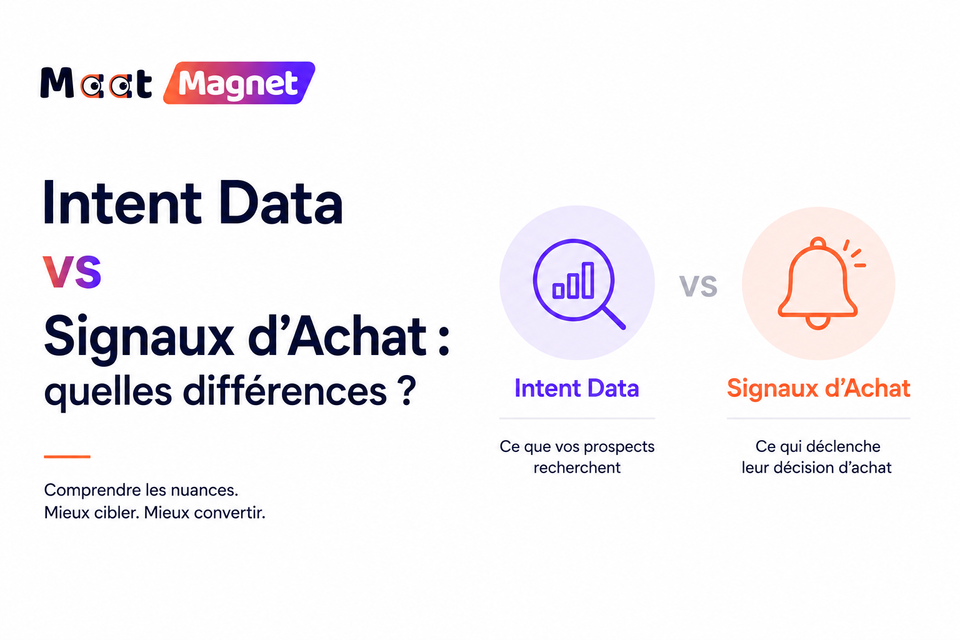
| Alternative solution 4 | Intent data scoring models | Advisory insights only | Enterprise data analysts |
| Alternative solution 5 | Cold calling dialer optimization | Purely manual tracking | Call center environments |
Takeaway: selecting the appropriate technology requires aligning the system's autonomous capabilities with the organization's specific growth methodologies.
Foire aux questions
How do intention signals differ from standard prospect lists?
Static lists provide demographic information like industry and job title without indicating immediate interest. Intention metrics track actual behaviors, such as analyzing competitor platforms or researching specific technical solutions, which indicate an active purchasing mindset.
Will automated systems integrate with legacy relationship management tools?
Yes, modern platforms utilize standard application programming interfaces to synchronize contact statuses bidirectionally. This ensures the central database remains the single source of truth without requiring massive IT overhauls.
Does artificial intelligence write messages that sound authentically human?
Advanced models analyze the writing styles, professional vocabulary, and structural habits of specific industries. They format messages that bypass standard marketing templates, creating reading experiences that mirror authentic human-to-human professional correspondence.
Can a small team genuinely replicate the volume of an enterprise department?
By removing the hours spent sourcing data, verifying contacts, and writing initial outreach emails, a small unit of closing specialists can handle the meeting volume traditionally generated by a department 5 to 10 times its size.
Scaling revenue architectures without proportionally scaling the workforce fundamentally changes organizational economics. When human capital is strategically reallocated from repetitive administrative outreach to high-value closing conversations, employee satisfaction and overall profitability align. Incorporating structural innovations driven by behavioral data ensures that every interaction adds value to the potential buyer. As the market transitions toward contextual relevance, enterprise teams leveraging precise, timely intelligence will naturally capture market share from organizations still relying on industrial-scale manual repetition.