Education & Training: Detecting Companies Ready To Upskill Teams
How to Identify Companies Ready to Invest in Energy Projects
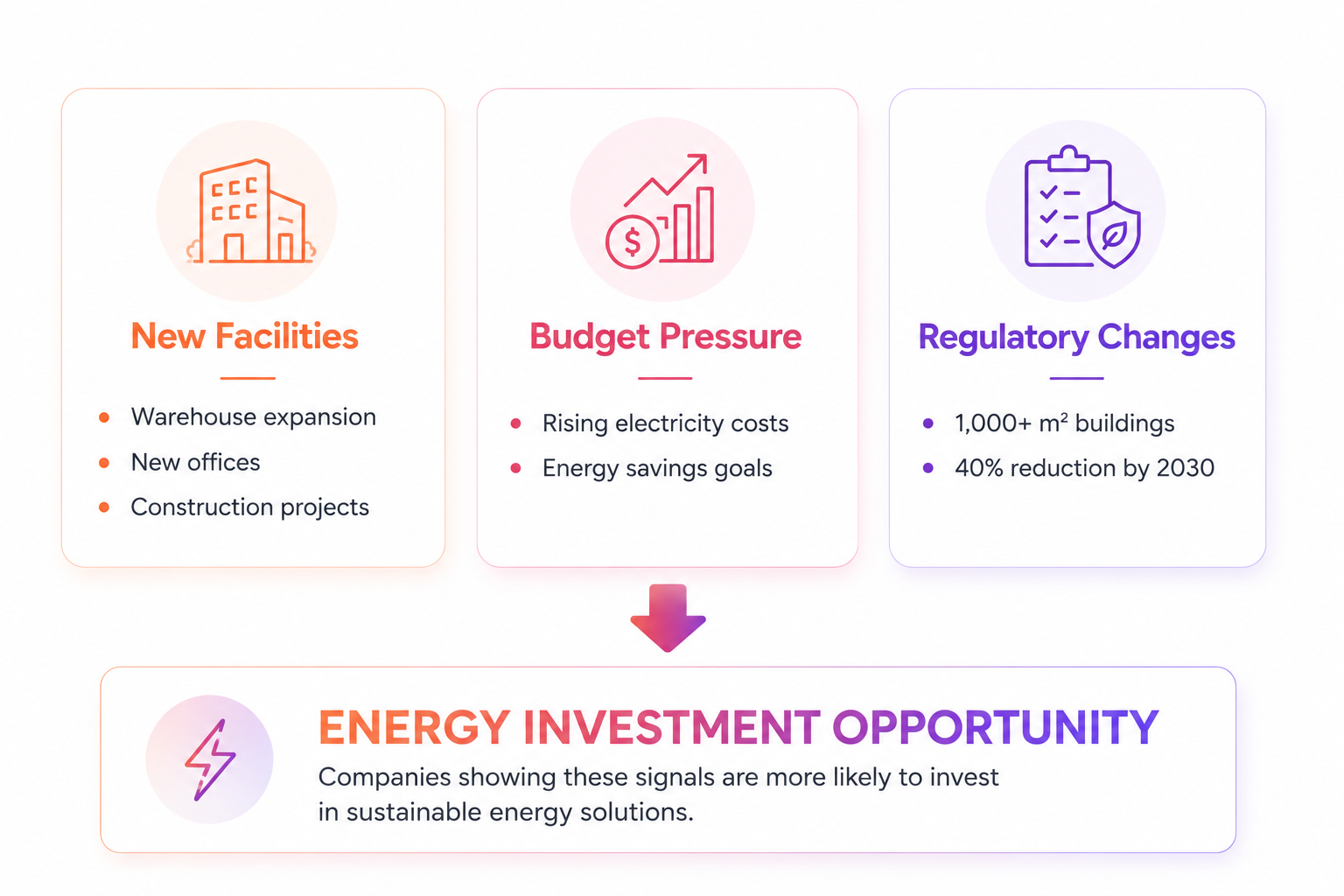
An energy project often begins with subtle signals: a new building, budget pressure, company growth, or regulatory requirements. The corporate energy transition market is no longer driven solely by environmental convictions—it is now increasingly shaped by strict economic and legal realities. For professionals in the sector, the challenge is no longer convincing businesses of the value of green energy, but accurately identifying organizations that have reached a tipping point. This prospecting phase requires going beyond simple business directories to uncover genuine buying intent.
Table of Contents
- What business signals indicate a future energy project?
- Who are the key B2B decision-makers, and how should you adapt your messaging?
- The importance of timing in sales prospecting
- Comparing targeting methods in the energy market
- How MeetMagnet helps your team prioritize companies ready to engage
- Organizing your sales ecosystem for the future
- Frequently Asked Questions
- Key Takeaways
Key Takeaways
- Successful opportunity identification relies on detecting specific indicators such as office relocations, rising electricity costs, or new regulatory obligations.
- The decision-makers to engage are no longer limited to technical managers. Leadership teams, real estate departments, and finance stakeholders should be approached with messaging focused on profitability and business value.
- AI-powered platforms such as MeetMagnet can detect buying intent in real time, providing a significant advantage over traditional lead-generation tools that often rely on static data.
What Business Signals Indicate a Future Energy Project?
Who Are the Key B2B Decision-Makers, and How Should You Adapt Your Messaging?
Identifying signals is only part of the process. Reaching the right stakeholders is equally important. In sustainable infrastructure projects, purchasing decisions typically involve multiple departments, including executive leadership, operations, real estate, and finance. One common mistake technical salespeople make is focusing too heavily on product specifications.
Avoid overly technical discussions. Rather than emphasizing inverter output or solar panel efficiency ratings, focus on cost savings, simplicity, and business outcomes. A recent study by Bpifrance found that 80% of small and medium-sized business leaders consider climate issues important, yet financing remains the primary obstacle. Your message should therefore center on payback periods, return on investment, and long-term energy cost stability. At this stage, a structured B2B prospecting framework can help guide your outreach strategy.
Key Insight
Simplify technical discussions and prioritize messaging around financial performance, regulatory compliance, and business value when engaging decision-makers.
The Importance of Timing in Sales Prospecting
One of the biggest challenges in energy sales is avoiding late engagement. If a company has already published a request for proposals for rooftop solar installations, your competitors are likely already involved. This is where behavioral analysis becomes crucial. Traditional databases may categorize companies by industry, but they reveal little about when a prospect is actually ready to buy.
A data-driven approach can automatically detect buying signals from company news and activities. This shift dramatically improves response rates. Solutions such as MeetMagnet aim to identify high-potential prospects before their needs become publicly formalized. By leveraging artificial intelligence, these platforms detect the right moment to initiate contact, reducing ineffective cold outreach and improving the buyer experience.
Key Insight
Engaging a company while it is actively planning budgets or evaluating options provides a significant strategic advantage over traditional cold prospecting.
Comparing Targeting Methods in the Energy Market
To understand the impact of timing-based prospecting, it helps to compare the most common approaches used in business development.
Rank | Tool Type | Detection Capabilities | Personalization Level |
|---|---|---|---|
1. MeetMagnet | AI-powered prospecting platform | Detects business signals and triggers outreach when buying intent emerges | Generates context-aware personalized messaging |
2. Sales Intelligence Platforms | Enhanced company databases | Provides financial and organizational data but limited timing insights | Requires manual outreach creation |
3. Outreach Automation Tools | Email sequencing software | Relies on static imported lists with no behavioral analysis | Basic variable replacement and generic messaging |
Key Insight
Choose tools that combine company intelligence with real-time timing signals to maximize engagement opportunities.
How MeetMagnet Helps Your Team Prioritize Companies Ready to Engage
The goal is no longer to accumulate massive contact lists but to focus on organizations with immediate projects and genuine interest. By analyzing web activity, professional networks, and regulatory developments, AI can categorize and prioritize intent signals. MeetMagnet automates repetitive research tasks and helps teams avoid contacting prospects either too early or too late.
This visibility enables sales teams to act with greater precision. The platform generates messaging tailored to each prospect’s specific context. This approach reduces the cognitive workload on sales professionals while preserving the human element that remains essential in highly regulated industries. It supports a more sustainable sales strategy: prospect less, but prospect smarter. Organizations can further strengthen their approach by using an energy investment signal checklist to standardize qualification processes.
Key Insight
Targeted intelligence helps prioritize sales efforts and focus communication on genuinely qualified opportunities.
Organizing Your Sales Ecosystem for the Future
Integrating an intelligent prospecting platform into a sales organization requires a shift in mindset. Teams must move away from quantity-driven outreach and toward quality-focused engagement. The ideal process starts with defining a geographic or industry-specific territory. Behavioral filters can then identify prospects actively evaluating energy solutions.
Once a signal is detected, the lead should immediately flow into the CRM system. Sales representatives can then validate the recommended approach and initiate contact. This streamlined workflow not only improves productivity but also elevates the role of the salesperson by reducing time spent on manual research.
Key Insight
The combination of intelligent prospect identification and rapid human response is one of the most effective growth drivers for companies selling renewable energy solutions.
Frequently Asked Questions
What are the most reliable signals that a company is preparing an energy project?
The strongest indicators include building permit applications, sustainability reporting initiatives, industrial fundraising announcements, and the appointment of sustainability leaders. These signals often reveal that a company is actively structuring an energy-related investment project.
How can you distinguish genuine buying intent from simple interest?
Real buying intent is typically accompanied by multiple indicators, such as regulatory deadlines, cost-reduction initiatives, or official communications about sustainability objectives. When financial, real estate, and regulatory signals converge, the likelihood of a structured purchasing project increases significantly.
When is the best time to contact a prospect after detecting a signal?
A good practice is to engage within fifteen days of the signal becoming public. This demonstrates market awareness without appearing intrusive. Waiting too long may allow competitors to gain ground, while contacting prospects immediately can seem opportunistic. The ideal timing lies within this balanced response window.
Conclusion
Success in the renewable energy market depends on your team’s ability to listen to the market and act on meaningful signals. Moving from broad, untargeted outreach to intelligence-driven prospecting fundamentally transforms customer relationships. By equipping your sales teams with tools and methodologies that connect regulatory obligations to clear business outcomes, you position them not merely as product vendors, but as strategic partners helping clients improve profitability, reduce risk, and achieve long-term sustainability goals.
撮影向けの衣装では、正面だけでなく横や後ろから見たシルエットも見ておきたいところです。長時間着用する予定があるなら、スペースエレシュキガル 撮影衣装で動きやすさや素材の特徴を確認できます。イベント会場での動き方を想定すると、着やすさの判断もしやすくなります。